
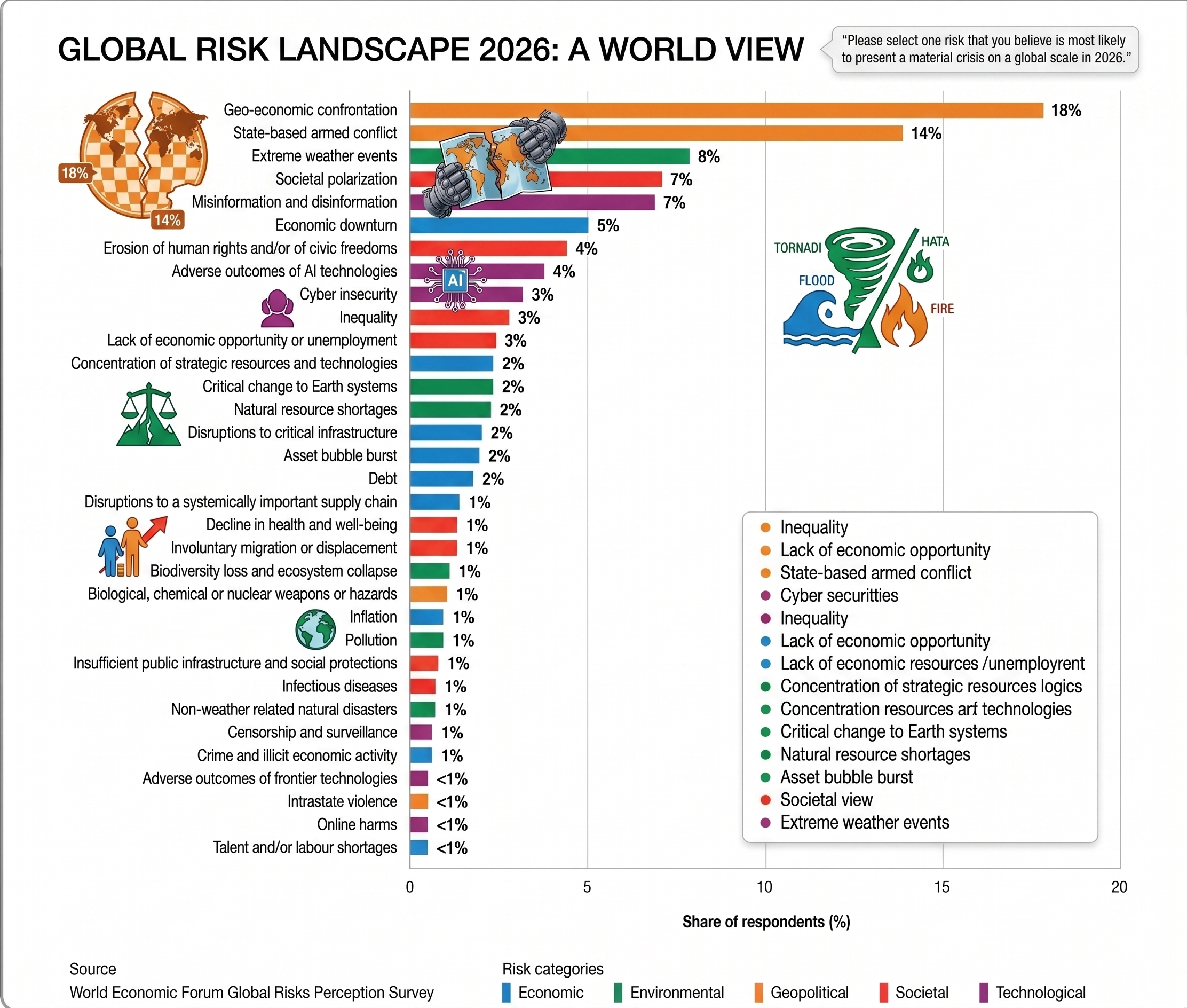
The release of the World Economic Forum Global Risks Report 2026 signals an important shift not in the nature of global risk itself, but in how that risk is being prioritised.
At first glance, the headline change is clear: geoeconomic confrontation now ranks as the most immediate global risk. Trade, finance, and technology are increasingly being used as instruments of competition. The global system is fragmenting into blocs, alliances are becoming more transactional, and economic tools are now central to geopolitical strategy.
This marks a departure from recent years. In 2025, state-based conflict dominated the global risk landscape. In 2024, environmental risks extreme weather, biodiversity loss, ecosystem collapse consistently ranked among the most severe threats, particularly over the long term.
In 2026, the hierarchy has shifted.
But the underlying reality has not.
https://www.weforum.org/publications/global-risks-report-2026/

A Reordering of Risk Not a Reduction of It
The most important insight from the 2026 report is not what has risen but what appears to have fallen.
Environmental risks, particularly in the short-term (2-year horizon), have declined in perceived urgency. Yet over the long-term (10-year horizon), they remain among the most severe and irreversible threats to global stability.
This creates a structural contradiction:
- In the short term, attention is shifting toward geopolitical competition, economic fragmentation, and technological rivalry.
- In the long term, the greatest risks remain ecological climate instability, biodiversity loss, and increasingly, water stress.
This is not a resolution of risk. It is a deferral of it.
And yet, in parallel, the WEF has declared 2026 the “Year of Water” elevating water from an environmental concern to a core issue of economic resilience, infrastructure, and global stability.
This is the paradox.
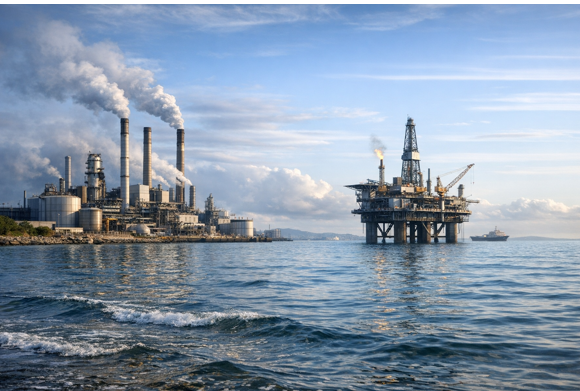
At the very moment environmental risks appear to be receding in priority rankings, one of their most critical components of water is being elevated to the centre of global economic discourse.
The Pattern: Systems Respond to What They Can Measure
This shift in attention is not accidental. It reflects a deeper structural bias.
Financial systems, policy frameworks, and markets prioritise risks that are:
- immediately visible
- quantifiable
- priced into existing models
- and directly linked to economic or political outcomes
Geoeconomic confrontation fits neatly into this structure. It can be tracked through trade flows, sanctions, capital movements, and supply chain disruptions. It produces signals that markets understand.
Environmental risk does not behave the same way.
Despite decades of awareness, much of the environmental economy biodiversity, ecosystem services, hydrological systems remains under-measured, inconsistently valued, and poorly integrated into financial decision-making.
As explored in our previous article Why the Year of Water Is a Bet Against Economic Shocks, this has constrained the scaling of nature-based investments. Without reliable, investment-grade data, environmental systems remain peripheral to capital allocation decisions.
What the 2026 Risk Report reveals, perhaps unintentionally, is the consequence:
Risks that are not fully measurable are more easily deprioritised even when they are more severe.
From Environmental Constraint to Economic Reality
The reprioritisation of risk does not remove environmental pressure it changes how it manifests.
Water is the clearest example.
No longer framed solely as an environmental issue, water is now emerging as a binding constraint on industrialisation, urbanisation, and economic growth. From energy production to agriculture, mining, and manufacturing, water availability is becoming a determinant of competitiveness.
This is precisely why the “Year of Water” matters.
It signals a transition: environmental systems are no longer externalities. They are becoming core economic infrastructure.
The same applies more broadly:
- Climate volatility is reshaping supply chains and price stability
- Biodiversity loss is influencing asset risk and long-term productivity
- Land degradation is constraining food systems and rural economies
Environmental systems are no longer separate from the economy and thereby industrialization efforts.
They are increasingly defining its limits.

The Missing Link: Environmental Data as Economic Infrastructure
The shift also exposes a critical gap: the absence of environmental data systems at the same level of maturity as financial or geopolitical intelligence systems.
Global markets operate with near real-time visibility on:
- interest rates
- trade flows
- capital allocation
- geopolitical developments
But equivalent systems for: water availability, ecosystem health, biodiversity change, land and soil degradation, remain fragmented and incomplete.
This is where the argument from our previous article becomes central.
We are entering a phase where environmental data and digitalisation are no longer optional they are foundational infrastructure for the next industrial era.
Advances in Earth observation, AI-driven environmental analytics, digital MRV (measurement, reporting, and verification) and natural capital accounting are beginning to close this gap.
For the first time, it is becoming possible to measure environmental systems with the precision required for investment, planning, and risk management.
A Misalignment Between Attention and Trajectory
The 2026 Global Risks Report highlights a deeper misalignment in global priorities. While public and political attention is shifting toward geopolitical tension and economic conflict, the long‑term trajectory remains dominated by environmental constraints. This gap between what captures attention and what drives risk continues to widen.
The elevation of water alongside the deprioritisation of broader environmental risks makes this tension even clearer. This is where systemic risk accumulates.
If institutions continue to prioritise what is most visible and measurable in the short term, while underinvesting in the systems that underpin long-term stability, the eventual correction will be more abrupt and more costly.
This pattern is familiar. It mirrors previous crises where risk accumulated in areas that were poorly measured and therefore underpriced. The difference now is that the underlying system is not only financial it is ecological.

What This Means for Business and Industrial Strategy
For business leaders, the implication is direct.
The next phase of industrial competitiveness will not be determined solely by technology or capital. It will be shaped by how effectively organisations understand and integrate environmental systems particularly water into their operations and strategy.
This requires:
- recognising dependencies on natural systems
- quantifying environmental constraints
- integrating environmental data into financial and operational models
- preparing for emerging environmental asset classes
As environmental pressures become embedded in economic systems, the distinction between sustainability and strategy will continue to collapse.
A Shift Still Waiting to Happen
The 2026 Global Risks Report does not suggest that environmental risk has diminished.
It suggests something more concerning:
Our systems of attention have shifted faster than our systems of reality.
The African Union declaration of 2026 as the Year of Water reinforces this highlighting that while attention may move, underlying dependencies cannot be deferred.
The challenge now is not only to respond to visible risks, but to build the data systems, financial architectures, and institutional capacity required to understand and act on the less visible, but more fundamental ones. This is where the future of green industrialisation will be determined.
Not only in energy or infrastructure but in the ability to measure, value, and manage the environmental systems that sustain economic activity.
The technology exists.
The signals are clear.
The question is whether we act before the gap between attention and reality becomes too wide to manage.